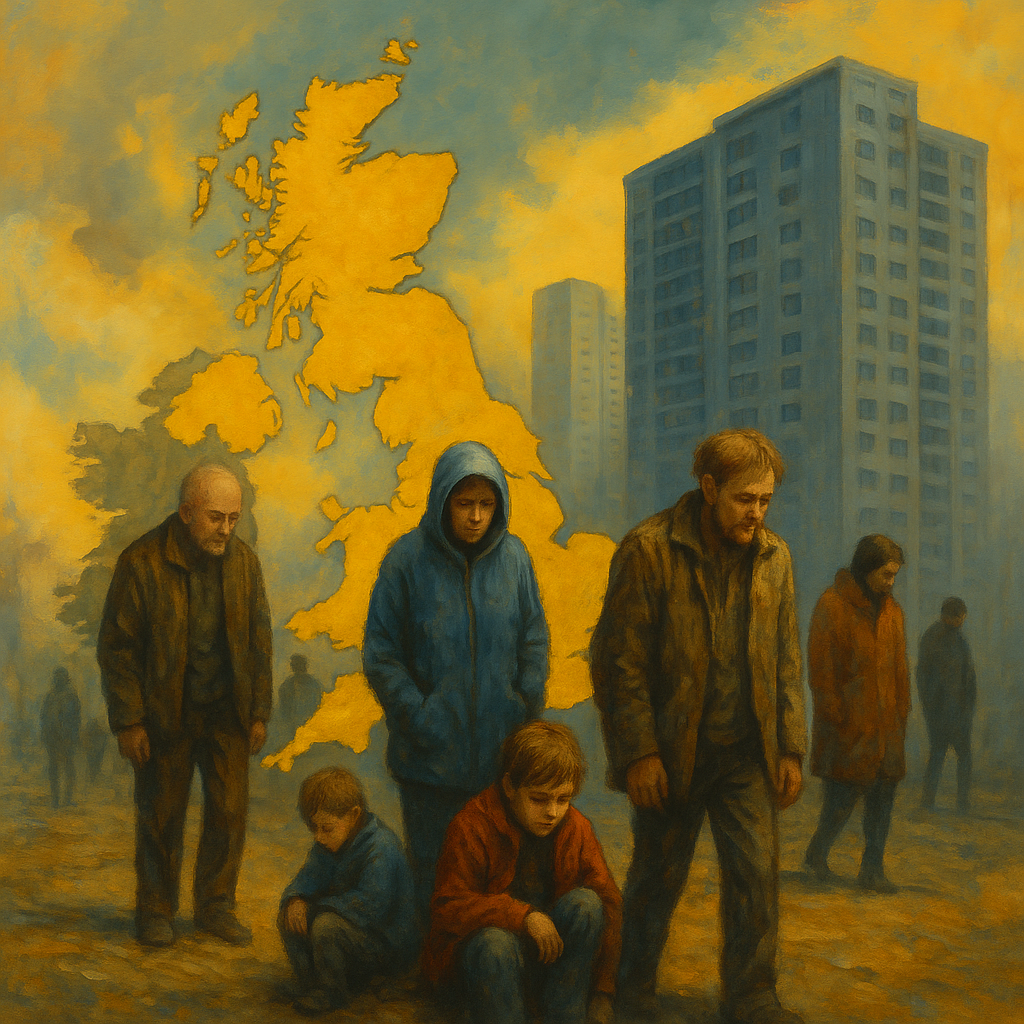
The recent release of the English Indices of Deprivation 2025 (IoD 2025) offers a sobering reminder: despite decades of policy, philanthropic and voluntary-sector effort, many parts of the UK remain locked into persistent, multi-domain disadvantage. With this data in hand, the question must shift from “What more can we do?” to “Are we doing the right thing, and is our model capable of what is required?” In this light, the framework advanced by Shift Beyond conversations, emphasising a disruption of current norms in civil society, peer-led agency, and a re-imagining of mission and structure becomes critically relevant.
The IMD 2025 ranks neighbourhood-level areas (LSOAs) by their levels of multiple deprivation across the seven domains: income, employment, education/skills, health/disability, crime, housing/services access, living environment.
Key points:
- Many LSOAs falling into the most-deprived deciles are highly disadvantaged across multiple domains rather than just one.
- Change is slow: some areas remain in the bottom decile across multiple releases of the Index (so-called “persistent deprivation”).
- The challenge is not simply income poverty, but a clustered set of disadvantages which often reinforce one another (e.g., poor employment + low skills + ill-health + insecure housing) and thereby lock places into disadvantage.
If we reflect on the objectives of the anti-poverty sector over recent decades – reducing disadvantage, increasing opportunity, building resilient communities – the data suggests that, in many places, those ambitions have not been met as fully as hoped. The structure of disadvantage remains entrenched.
We must ask: if so many parts of the sector are committed, funded, and active, why is persistent multi-domain deprivation still so visible? Some of the reasons can be traced to the architecture of civil society and the design of “impact-centres” as they currently function.
- Fragmentation and siloed missions
Many charities, social-enterprises and community organisations specialise in one domain: food security, debt advice, skills training, housing support, community health. Yet the IMD shows that individuals in high-deprivation neighbourhoods often face combined challenges across domains. As a result, a collection of siloed services may struggle to tackle the compounding effects of multi-domain disadvantage. - Service-delivery rather than system redesign
Much of the sector focuses on service provision: delivering to those in need, responding to crisis. This is vital, yet if the core structural challenge is interwoven disadvantage, then reacting to it may have limited transformative effect. The sector may be better geared to mitigate rather than eradicate. The anti-poverty ambition requires redesign of systems, not only delivery of programmes. - Top-down models, limited community agency
Many organisations are structured in hierarchical ways, with leadership and funding decisions largely above community actors. While community organisations exist, the broader ecosystem still tends to treat “beneficiaries” as recipients rather than co-creators of change. Shift Beyond emphasises shifting power to community agency, yet many impact-centres retain traditional power dynamics. - Measuring what is easy, not what matters most
With multiple deprivation showing entrenched disadvantage, the focus of many charities on outputs (people served, sessions delivered, meals supplied) may not align with the harder-to-measure but deeply important outcomes (community resilience, inter-generational mobility, dismantled systems of disadvantage). The status-quo model is not always calibrated for the long-haul structural change needed. - Scaling the wrong thing
Scaling has become a mantra: more reach, more sites, more beneficiaries. But if the underlying model is flawed (fragmented, service-led, siloed) then scaling doesn’t necessarily translate into deeper structural impact, it may simply reproduce the same patterns in more places. The persistence seen in the IMD data suggests that more of the same will not suffice.
The language of Shift Beyond invites us to go further: to imagine civil society not simply as “impact-centre doing good” but as a transformed ecosystem of community-led action, networked infrastructure, and systemic redesign. Key elements include:
- Peer-led agency: shifting from ‘service users’ to ‘co-creators’. Communities most affected by disadvantage are not passive recipients but must be given voice, resource and structural role in designing responses.
- Open, networked platforms: rather than discrete programmes, a network architecture that connects people, referrals, support, skills, peer-networks and systems change through digital and local infrastructure.
- Multi-domain alignment: the model must reflect the cross-domain nature of deprivation. That means designing interventions that integrate employment, housing, health, skills and community agency rather than addressing them individually.
- Distributed power, transparency and shared leadership: the sector must embrace new governance, open access, decentralised decision-making, aligned with the ethos of democracy and equity.
- Metrics of deeper change: shifting from throughput to transformation: measuring community resilience, sustained mobility, changes in structural disadvantage.
- Adaptive funding and partnerships: funders and charities alike need to embrace risk, innovation and learning-rich models, rather than rigid programmes whose logic ends at “deliver and report”.
In short: the civil society model needs to transition from a “helping” paradigm to a “co-creating” paradigm.
- The data demands it: The IoD 2025 shows not only the scale but the persistence of disadvantage. When many areas remain locked in disadvantage across time, the case for incremental service-improvement is weak, what is required is structural redesign.
- Policy momentum: Governments are increasingly acknowledging the limits of siloed policy and are looking for joined-up, community-driven models. The sector must align with this shift.
- Technology & network infrastructure: Digital platforms, referral systems, community data-tools and distributed networks now offer possibilities that earlier models lacked, opening the door to redesigned civil society architecture.
- Funding pressure: With public finances constrained and demand rising (cost-of-living, health, inequality), charities and social enterprises cannot assume old models will be sufficient or sustainable.
For leaders in the sector, the narrative of “scale what works” must be replaced by “design what is needed”. Questions to ask:
- Are we working in silos? How might our work better integrate with other domains of disadvantage?
- Do the people we serve have structural voice, decision-making power and agency within our organisation or network?
- Are we tracking the outcomes that matter for structural change (mobility, community leadership, systems shift) or only the outputs we can easily measure?
- Are we building platforms and networks rather than isolated programmes?
- Are our funding and governance models aligned with distributed power, iteration and adaptation?
For funders:
- Move away from short-term, output-based funding to sustained investment in community ecosystems, capacity building and platform infrastructure.
- Encourage collaboration across charities, social enterprises, community groups, and cross-domain action (employment, housing, health, skills).
- Support innovation in governance: community-led boards, participative decision-making, digital infrastructure for local networks.
For policy-makers:
- Recognise that civil society is part of the infrastructure of welfare and societal resilience, not simply supplementary to it.
- Invest in ecosystem-building, not only service contracting.
- Use IMD and other data to map where interventions need redesign, and incentivise models that reflect multi-domain disadvantage rather than single-issue fixes.
The data offered by the IMD 2025 is not an indictment of individual charities or community actors, many are doing extraordinary work under difficult conditions. But it is an indictment of the system the sector has inherited. Simply doing more of the same is unlikely to shift neighbourhoods out of entrenched disadvantage. The architecture of civil society – its networks, funding models, governance, delivery logic – needs redesign.
The narrative of Shift Beyond invites us into that redesign: a civil society built around community agency, open networks, multi-domain alignment, platform logic, distributed power and transformational metrics. In short: not simply “fixing” people in need, but building communities of freedom, agency and flourishing.
In a moment when policies, public services and social enterprises are under pressure, the invitation is clear: we must move beyond the status quo of charity and impact-centre thinking, and invest in the civil society of the future – one aligned to the data, resilient, democratised and designed for the complexity of today’s challenges.